


The Pyramids of Giza – tickets and practical advice (2026)
Pyramids of Giza – an unforgettable journey to the edge of the desert
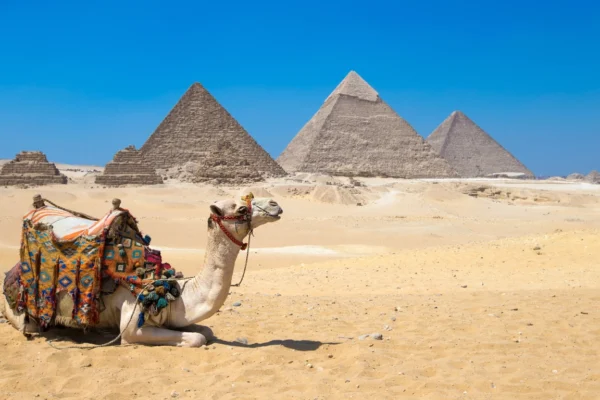
The Pyramid of Cheops. Known also as the Great Pyramid of Giza – the only one of the Seven Wonders of the Ancient World to have survived to the present day. This monumental tomb of the Egyptian king Cheops, also known as Khufu, was built around 4,500 years ago. Originally, it stood approximately 500 feet (147 metres) tall and remained the tallest man-made structure for some 3,800 years. To this day, we do not know all the details of how it was built…
Right next to it stands the Pyramid of Khafre, son of Cheops. It is slightly shorter, but because it was built on a higher part of the Plateau, from many vantage points it actually appears larger. At its summit, you can see the best-preserved section of the light-coloured limestone casing that once covered the pyramids almost entirely. Khafre’s funerary complex was also more extensive than his father’s – its temples were larger and more elaborate. And indeed, Khafre himself is regarded as a better ruler than his father.
A little further on stands the Pyramid of Menkaure, probably the son of Khafre and grandson of Khufu. It is by far the smallest of the three: originally, it was approximately 200 feet (65 metres) high. It also bears perhaps the most interesting damage of all three. A huge vertical gash on its northern face is the result of a medieval attempt… to dismantle the pyramid. You’ll hear about the mastermind behind this demolition, as well as plenty of other interesting facts about the pyramid complex, in our audio guide.
A little further away lies the Great Sphinx – a monumental sculpture with the body of a lion and a human head, carved directly out of the limestone rock of the Plateau. It was probably associated with Khafre’s funerary complex. However, no text from the time of its construction has survived to explain explicitly why it was created or what it was originally called.
What else is there to see around the pyramids?
The three Great Pyramids stand on the Giza Plateau, on the western edge of the Greater Cairo metropolitan area. In photographs taken several decades ago, they appear to stand almost alone in the desert. Today, the built-up area of Giza encroaches on the archaeological site from the east and north, and the contrast between the desert, the ancient monuments and the city of several million people is one of the most remarkable features of this place.
The pyramids are merely the most visible part of a vast necropolis. Each royal complex also included two funerary temples, the upper and lower, a processional way, smaller pyramids of the queens and mothers, mastabas for dignitaries and tombs of members of the royal family. Archaeologists have also discovered pits containing royal boats nearby. The entire area forms part of the ‘Memphis and its Necropolis – the Pyramid Fields from Giza to Dahshur’ complex, inscribed on the UNESCO World Heritage List in 1979.
It is also worth straying from the most obvious route, even for a moment. To the east and west of the Pyramid of Cheops lie cemeteries containing dozens of mastabas. Members of the royal family and the highest-ranking state officials were buried there. Among them is the extremely interesting tomb of Queen Meresanch III, featuring some of the best-preserved reliefs from the Old Kingdom.
Right next to the Plateau lies another must-see attraction: the Grand Egyptian Museum, or GEM. The museum officially opened on 1 November 2025 and is situated just 1.5 miles (2 kilometres) from the pyramids. You can therefore combine a visit to the Pyramids of Giza and the Grand Egyptian Museum in a single day, although it will be a very busy one. Or, better still, allow two days. You can also explore the Grand Egyptian Museum with our audio guide!
How do you enter the Giza Pyramids site?
For many years, the main entrance was on the side of the Mena House Hotel. Since 2025, however, the main entrance to the complex has been the new gate on Cairo–Fayoum Road, on the south-western side of the Plateau. A large visitor centre, car park, and other tourist infrastructure have been built here. The old entrance at Mena House is no longer the main gate.
If you’re travelling by Uber or taxi, it’s worth making clear that you want to go to the new Visitor Centre / Fayoum Gate, rather than simply entering ‘Pyramids of Giza’. Many older websites, videos and guidebooks still direct visitors to the former entrances.
Access to the pyramid complex from the Sphinx side is still available, but the rules regarding entry through this gate and ticket sales are subject to change. If you haven’t bought a ticket in advance, the safest option is to begin your visit at the new main entrance.
The Grand Walkway between the GEM and the pyramids
A tourist promenade connecting the Grand Egyptian Museum with the pyramid complex has also been built. It is approximately 0.8 miles (1.27 kilometres) long and runs from the museum grounds towards the Plateau. It was designed for both pedestrians and environmentally friendly electric vehicles.
This is a significant change, as the aim is for the GEM and the pyramids to function effectively as one large tourist area. The promenade itself has already been built, but as of September 2026, it is not yet open to the public. If you’re planning to walk from the Grand Egyptian Museum to the pyramids, it’s worth checking on site the day before to see whether the entire route is open to general tourist traffic.
Tickets to the Pyramids of Giza
A standard ticket grants access to the Giza Plateau, allowing you to see the pyramids from the outside, the Great Sphinx, the temples and most of the archaeological site. Entry to the interiors of the main pyramids, however, requires additional tickets.
According to the official price list in force at the time of writing, in September 2026, a standard ticket for a foreign visitor costs 700 EGP. Separate fees apply, among other things, for entry to the Great Pyramid of Khufu – 1,000 EGP, the Pyramid of Menkaure – 280 EGP, and the tomb of Meresankh III – 200 EGP. Prices in Egypt change quite frequently, however, so it is definitely worth checking the current official price list before your visit.
Access to the interiors of individual pyramids may also vary. The Pyramids of Khafre and Menkaure are sometimes opened and closed alternately for conservation reasons. I therefore wouldn’t rely too heavily on information from a guidebook published even a few months earlier – it’s best to check availability on the day of your visit.
Is it worth going inside the Pyramid of Cheops?
In my opinion – at least once in your life, yes. But it’s good to know what to expect.
You won’t see any paintings, hieroglyphs, gold or the pharaoh’s mummy inside. The interior of the Great Pyramid is austere. The main attraction is the journey itself: narrow corridors, followed by the remarkable Grand Gallery and, finally, the King’s Chamber with its granite sarcophagus. Cheops’ Pyramid has three known main chambers, two of which are located high above ground within the massive structure – a feature unique among Egyptian pyramids.
However, be prepared for high temperatures, stifling air and very narrow passages. In some sections, you have to climb at a steep angle, and there is very little room for two people to pass each other. Those suffering from claustrophobia, back problems or mobility issues are unlikely to enjoy the experience.
And yet, the feeling when, after a dozen or so minutes of squeezing your way through the interior of a monument more than four thousand years old, you find yourself standing in the King’s Chamber is hard to compare with anything else.
As for when to go and how to get around the Plateau – we cover that in this post.
More on our Blog
Pyramids of Giza – When to Visit and How to Explore
When is the best time to visit the Egyptian pyramids? You can visit Giza all year round. But the best time to explore