


Pyramids of Giza – When to Visit and How to Explore
When is the best time to visit the Egyptian pyramids?
You can visit Giza all year round. But the best time to explore the pyramids is from late autumn to early spring, roughly from November to March. This is considered the peak tourist season in Egypt.
July and August are a completely different story. Temperatures can exceed 104°F (40°C), and the Giza Plateau is almost entirely devoid of shade. Walking in such heat under the blazing sun is not the most pleasant experience. Water, a hat, sunglasses and high-factor sun cream are absolute essentials. Hotels are, of course, slightly cheaper at this time of year.
Whatever the season, it’s worth arriving at the gates early in the morning if you can. Firstly, it’s cooler. Secondly, organised tours tend to reach Giza a little later, so arriving early will help you avoid, at least to some extent, the main wave of visitors. You’ll notice the difference particularly when entering the Pyramid of Cheops: its corridors are very narrow, and having to squeeze past groups of tourists certainly doesn’t make the visit any easier.
Also bear in mind the light – particularly if you enjoy photography. Lighting conditions change considerably throughout the day. The Sphinx faces east, so its face is favourably lit in the morning. The main viewpoint, on the other hand, lies to the south-west of the three Great Pyramids, making it worth visiting in the afternoon. Night has its own charm too, especially during the ‘sound and light’ show held by the Sphinx each evening (please note: due to renovation work, these shows have been suspended since the end of 2025; check here for details).
How much time should you set aside for visiting the pyramids at Giza?
For an absolute minimum – the Pyramids of Cheops, Khafre and Menkaure, the panoramic viewpoint and the Sphinx – I’d allow about three hours. However, if you want to go inside the Great Pyramid, visit the cemeteries, see the tomb of Meresankh, stroll among the monuments and take your time by the Sphinx, five to six hours would be a reasonable estimate. It’s also worth stopping at one of the bars near the south-western viewpoint. Coffee and a snack with a view of the pyramids is an unforgettable experience, although don’t expect any culinary delights.
The Pyramids and the Grand Egyptian Museum in a single day
Visiting the Pyramids and the GEM on the same day is, of course, possible, although it will be long and tiring. These two attractions alone can easily fill two days. The GEM itself requires at least two to three hours; in that time, you’ll manage to see, above all, the Grand Stairway, the Tutankhamun galleries and Khufu’s solar boats (we’ve got an audio guide for you!). Unfortunately, a large proportion of tourists visit the Plateau as part of organised tours – so that may be exactly the sort of day you’ll be facing. In this article, we offer tips on how to plan a short visit to the Grand Egyptian Museum.
The Pyramids of Giza: on your own or with a guide?
As we mentioned, most tourists visit the Plateau as part of organised tours. This obviously makes getting there easier, but it severely limits your freedom. It’s worth remembering that you don’t need an organised tour to explore the pyramids. And since this year, 2026, thanks to the new entrance, buses and a clearer transport system, visiting the complex on your own is easier than it was just a few years ago.
For a self-guided tour, it’s well worth taking our audio guide. It will help you better understand the history of this fascinating place, as the information available on site is, to put it mildly, rather sparse. After all, beneath your feet lie the remains of temples, tombs, processional ways, workers’ settlements and cemeteries, which together form one of the most extraordinary archaeological landscapes in the world.
And that’s precisely why it’s worth setting aside a little more time for Giza. The Great Pyramid is, of course, the main attraction. But the site only becomes truly fascinating once you stop thinking of it as merely three pyramids standing in the desert. It is a vast city of the dead, dating back more than four and a half thousand years.
Buses, walking, camels and horse-drawn carriages
Just a few years ago, private cars – yes, you could enter in your own or rental car – coaches, taxis, camels, horses and horse-drawn carriages all moved around the complex. It was quite chaotic. Today, visiting the site is completely different. Private cars and coaches remain at the entrance, while electric buses travel across the Plateau. The route includes seven main stops, including the viewpoints, the Pyramid of Menkaure, the Pyramid of Khufu and the Sphinx.
It’s a major change. Getting to any of the main sights now takes just a few minutes, or at most around a dozen. You can take buses between the main attractions and walk where it’s really worth it. There’s still plenty of walking, of course: for example, the route around the base of the Pyramid of Cheops is approximately 0.6 miles (1 kilometre) long.
But what about camels and horse-drawn carriages? A camel ride in Giza is no longer the main way of travelling between the monuments. Today, it’s an additional attraction, with horses, camels and carriages following separate routes away from the main roads. If you’re looking for this sort of experience, stop at the main panoramic viewpoint to the south-west of the pyramids, the first stop when approaching from the New Gate. Alternatively, head to the area between the Pyramids of Khufu and Khafre.
The best viewpoint for the pyramids
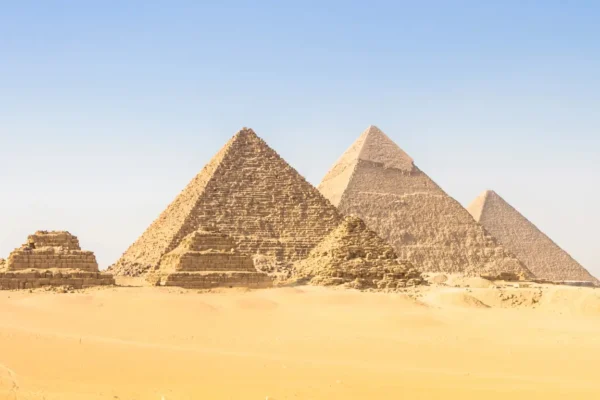
Don’t limit yourself to a photo from the foot of the Pyramid of Cheops. The best viewpoint is the first bus stop mentioned above, to the south-west. This is where the classic photographs are taken, showing all three Great Pyramids side by side, often with the smaller queens’ pyramids in the frame as well. Another classic view can be found by the Great Sphinx, with the Pyramid of Khafre rising behind it. We’ve written more about interesting viewpoints, of course, in our audio guide.
More on our Blog
The Pyramids of Giza – tickets and practical advice (2026)
Pyramids of Giza – an unforgettable journey to the edge of the desert The Pyramid of Cheops. Known also as the Great Pyramid